
FUN. CREATIVE. EVENTS.
Event Planning Tips
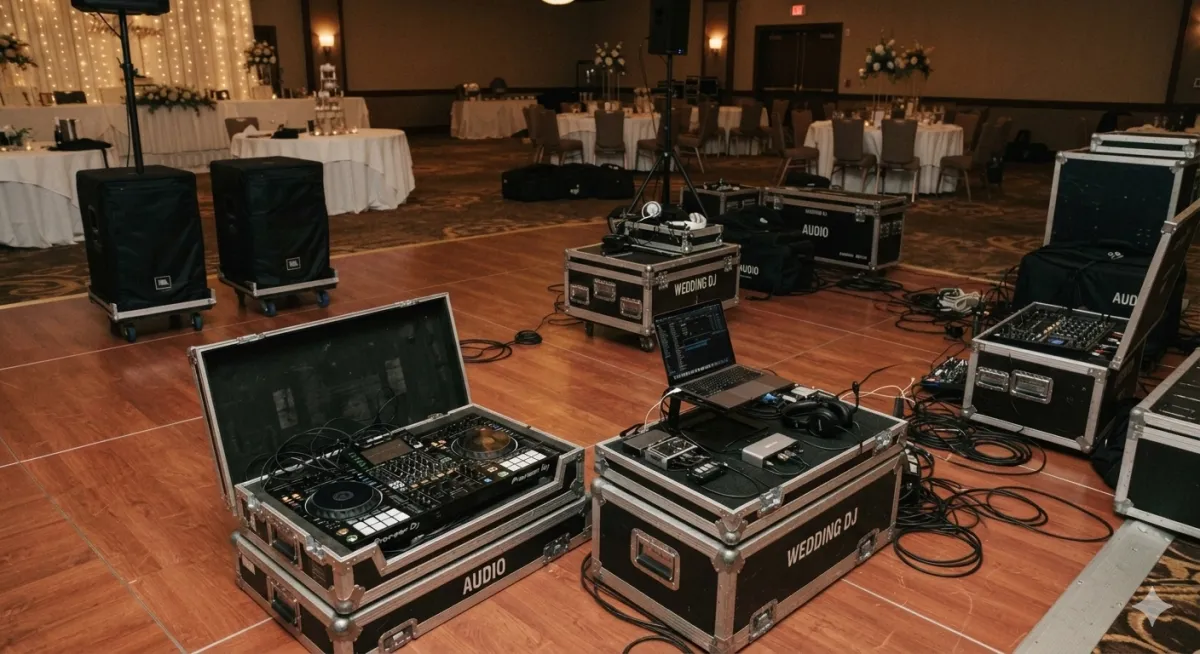
What You're Actually Paying a Wedding DJ For
Is a wedding DJ really just a few hours of work?
You're not paying for six hours. That's the part everybody sees, so that's the part everybody does the math on — take the price, divide by the hours, and it looks insane. But the hours you see are the last thing that happens, not the thing you're buying. Here's what's actually in the number.
Do that math on any wedding vendor and it falls apart. Your photographer isn't charging you for the shutter clicks. Your florist isn't charging you for stems.
You're not renting speakers. You're buying an outcome — a reception that moves, that stays on schedule, that your guests remember. The gear is how it gets delivered. It isn't the thing.
What happens before the wedding day?
Most of the work, honestly. Before I ever load a speaker into a van:
Meetings and planning calls, working out what you actually want
Building the timeline, then rebuilding it when the caterer shifts
Coordinating with your photographer, planner, venue, and officiant so we're all painting the same picture
Digging for your music — including tracks that don't exist in a usable form yet
Custom edits: mapping tempo and key so your first dance mix doesn't lurch
Rehearsing names and pronunciations until I don't have to think about them
Visiting or studying the venue — layout, power, sound limitations
Testing every piece of equipment, and the backups for that equipment
None of that is on the invoice as a line item. All of it is why the day works.
How many jobs is a wedding DJ actually doing?
This is the part I wish more couples saw. On your wedding day, one person is doing all of this:
Setup and breakdown crew — hundreds of pounds of gear, in and out, usually alone
Audio technician — when something fails mid-reception, someone has to fix it live, in a suit, without anyone noticing
DJ — reading the floor and choosing what plays next, in real time
MC — running the room out loud, keeping guests informed and moving
Event coordinator — keeping the day on schedule when it starts to drift
Industry knowledge — a decade-plus of knowing what usually goes wrong and when
That's not one job. It's many jobs all in one, and most professional companies send a crew of two or more to cover it. I do it solo, which is a choice about accountability, not about corners.
Think of spinning plates. It's not enough to be present.
What does "cheaper" actually get you?
There's always someone cheaper. The real question is: cheaper turns into what?
Sometimes it's fine. A 40-guest backyard party with a buddy and a speaker can absolutely work, and I'll tell you so.
But at a full wedding, cheaper usually turns into somebody who learned the gear and never learned the room. The playlist runs. The announcements land flat or late. Nobody catches the problem before your guests do. Nothing catastrophic happens — the reception just quietly never takes off, and nobody can point to why.
The gap between a good DJ and a cheap one isn't equipment. It's whether anyone's actually running your wedding.

Why does any of this matter?
Because every wedding is the Super Bowl. One shot, no do-overs, no going back to fix it Monday.
The value lives in the parts nobody plans for. The song that changes because the floor is thinning. The toast that starts two minutes late because someone's still hugging their mom, and gets handled so smoothly it looks intended. You can't put those on an invoice, and they're the entire job.
That's what the number is. Someone who cares about your day as much as you do, and knows there's no second try.
Planning a Sacramento wedding? Tell me your date and venue and I'll walk you through exactly what's in the price for your day — no pressure, and no math tricks.